
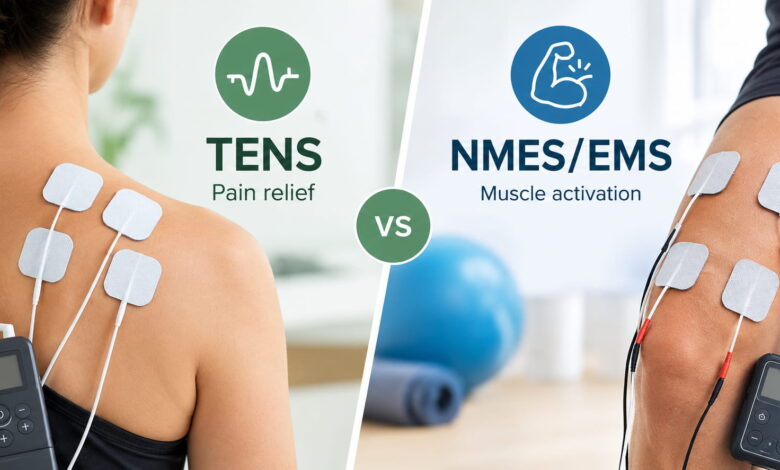
Every clinic eventually faces the same equipment decision: a patient walks in with pain that needs calming, another needs a weak or inhibited muscle woken back up, and the treatment room only has so much budget for stimulators. That’s where understanding TENS vs. NMES/EMS becomes important. Buy the wrong unit and you’re either stuck sending patients home with a device that doesn’t match their condition, or explaining to a practice owner why a $1,500 stimulator is gathering dust.
This guide breaks down what separates TENS from NMES/EMS, when each one actually belongs in a treatment plan, and which real devices from Canadian suppliers are worth putting on your shortlist.
TENS vs. NMES/EMS
TENS (Transcutaneous Electrical Nerve Stimulation) targets sensory nerves to reduce the perception of pain. NMES/EMS (Neuromuscular or Electrical Muscle Stimulation) targets motor nerves to produce an actual muscle contraction. TENS calms pain signals; NMES makes a muscle work. Most clinics end up needing both, which is why combo units that run both modes on separate channels are the most commonly stocked equipment in Canadian physio, chiro, and athletic therapy clinics today.
If you’re stocking a treatment room or replacing an aging stimulator, the decision usually isn’t “TENS or NMES.” It’s whether a combo unit covers your caseload, or whether you need separate dedicated devices for volume reasons. Here’s how the two technologies actually differ, and what practitioners typically choose to stock.
What TENS Actually Does
TENS delivers a low-level electrical current through surface electrodes to stimulate sensory nerve fibers rather than motor fibers. The leading explanation for its pain-relieving effect is the gate control theory, proposed by Melzack and Wall in 1965. According to this theory, TENS stimulates large-diameter, fast-conducting sensory fibers.
This stimulation helps close a “gate” in the dorsal horn of the spinal cord, which can reduce the transmission of slower pain signals to the brain. TENS may also stimulate the release of endogenous opioids, the body’s own pain-relieving chemicals. This mechanism appears particularly relevant when TENS uses lower frequencies.
Patients typically feel a tingling or buzzing sensation rather than a muscle contraction. TENS units are used for symptomatic pain relief in conditions ranging from arthritis to post-surgical pain to chronic low back pain, and they’re often sent home with patients between clinic visits.
What NMES/EMS Actually Does
NMES and EMS refer to the same underlying technology (the terms are used interchangeably in most Canadian clinical catalogs, though “NMES” is more common in rehab literature and “EMS” more common in fitness contexts). Instead of targeting sensory nerves, NMES depolarizes motor nerve fibers directly, producing an involuntary muscle contraction that mimics voluntary exercise.
Clinically, this is used to retard or prevent disuse atrophy, maintain or increase range of motion, re-educate muscles after injury or surgery, reduce muscle spasm, and support neuromuscular re-education in neurological populations.
Recent research also shows NMES engages corticomotor pathways, meaning it isn’t purely a peripheral effect: it recruits central nervous system structures too, which helps explain why it’s used in stroke and post-ACL rehab protocols, not just general deconditioning.
TENS vs. NMES: Understanding The Core Differences
| TENS | NMES/EMS | |
|---|---|---|
| Target | Sensory nerves | Motor nerves |
| Primary goal | Pain relief | Muscle contraction |
| Sensation | Tingling, no visible movement | Visible or palpable muscle twitch/contraction |
| Typical frequency | Higher (80–120 Hz conventional) or low-rate/acupuncture-like | Lower, work/rest cycled |
| Common uses | Chronic pain, post-op pain, arthritis | Atrophy prevention, muscle re-education, spasm reduction |
| Take-home use | Very common | Less common, more clinic-supervised |
When Clinics Reach for TENS
TENS gets pulled out for patients whose primary complaint is pain rather than weakness: acute low back pain, osteoarthritis flare-ups, post-surgical incision pain, or chronic conditions like fibromyalgia.
Because units are portable and simple enough for patient self-management, TENS is also the modality clinics are most likely to send home, either as a rental, a purchase, or through an insurance benefit claim.
When Clinics Reach for NMES/EMS
NMES shows up in rehab plans where the problem is a muscle that isn’t firing properly, not just pain. Post-ACL reconstruction quad activation, post-stroke muscle re-education, disuse atrophy after immobilization, and pelvic floor rehabilitation are common applications.
Athletic therapists also use NMES for active recovery and blood flow support between training sessions. This is generally a supervised, in-clinic modality more often than a take-home one, particularly at higher intensities.
Why Many Clinics Stock Combo Units Instead of Choosing
In practice, most multidisciplinary clinics don’t stand at a fork between TENS and NMES. They stock combo stimulators that run both modes, often on independent channels, so one device can treat a post-op knee (NMES) in one room and a chronic pain patient (TENS) in the next.
Some combo units go further and sequence the two automatically within a single program: starting with a TENS phase to bring pain down, switching to NMES for muscle re-education, then closing with a second TENS phase for lasting relief after the session. For a mixed caseload, that flexibility is usually worth more than the marginal savings of buying single-mode devices.
Contraindications and Precautions Practitioners Should Already Know
Both technologies carry a well-established safety profile, but neither is appropriate for every patient. Electrical stimulation of any kind (TENS or NMES) should generally be avoided or used only with medical clearance in patients with:
- Cardiac pacemakers or implantable defibrillators, since electrical pulses can interfere with device function
- Epilepsy or seizure disorders
- Pregnancy, particularly stimulation across the abdomen or lower back
- Active malignancy in the treatment area
- Broken, infected, or irritated skin at the electrode site
- Placement directly over the carotid sinus, throat, or chest in a way that crosses the heart
This is general clinical background, not a substitute for your regulatory college’s practice guidelines or the specific unit’s instructions for use. Confirm current contraindication lists against your professional body’s standards before treating.
What to Check Before You Buy a Unit
A few practical factors separate a unit that earns its shelf space from one that gets pushed to a back drawer within a year:
- Channel count – Two channels cover most single-region treatments. Four channels let you treat two body regions, or two patients, at once, which matters for busy clinics.
- Program depth versus simplicity – Units with 30 to 60+ preset programs are useful for varied caseloads, but a smaller clinic doing mostly pain management may prefer a simpler interface staff can train on in minutes.
- Wired versus wireless – Wireless stimulators free the patient to move (walk, do active exercise, use a treadmill) while receiving stimulation, which matters for functional rehab protocols.
- Portability for take-home use – If you plan to rent or sell units to patients, battery life, display clarity, and lock functions (to prevent accidental parameter changes) matter more than clinic-only devices.
- Warranty and local support – Given the equipment sees daily use, a two-year-plus warranty and a Canadian supplier who can service or replace units quickly reduces downtime.
TENS and NMES/EMS Devices Worth Comparing
Finding the right TENS or NMES unit shouldn’t mean opening several browser tabs and comparing specs by hand. Clinics researching electrotherapy equipment often run into the same wall: channel counts, program libraries, and pricing are scattered across supplier sites with no easy way to compare them side by side. Here’s what five of Canada’s leading electrotherapy suppliers actually carry, so you can match a unit to your caseload without the guesswork.
MEDELCO
MEDELCO Inc carries a wide combo and dedicated lineup built for Canadian practice settings. The Chattanooga Theta Combo Stimulator is a 4-channel TENS and NMES unit with 63 programs and optional Mi (Muscle Intelligence) technology that scans and adjusts to a patient’s physiology.
The Chattanooga Continuum offers 2 independent channels with 13 pre-programmed and 2 custom regimens, plus hand switch and optional foot switch control, well suited to clinics running active rehab protocols. For clinics wanting one device that sequences both modalities automatically, the PHASE-5 Combo runs up to 5 phases per session, blending TENS and NMES programs.
Compact options include the Cefar Rehab X2 (30 programs) and the StimTech NEO, a portable TENS/EMS/IFC/microcurrent unit with 40 programs and a lithium rechargeable battery. The TwinStim Plus 2nd Edition adds a 4-channel combo option intended for pain relief, muscle re-education, and circulation support.
Physio Supplies Canada
It stocks a comparable Chattanooga range alongside the Compex line. Its Chattanooga 2 Channel Wireless NMES/TENS and 4 Channel Wireless Professional Standard unit (which ships with two remotes) target clinics prioritizing patient mobility during treatment.
The Chattanooga Continuum TENS/NMES Kit and the Cefar Rehab X2 appear here too, alongside Compex Fit 5.0 and the SP 4.0 through SP 8.0 series, which lean toward sports performance and recovery applications. The PRIMERA TENS/NMES unit with HAN waveform and the COMBO STIMULATOR LT7102 (a TENS/EMS/IFC combo with a color screen) round out the mid-range options.
Canada Clinic Supply
It carries NeuroTrac’s TENS and NMES lineup, including the NeuroTrac Rehab TENS/NMES with an on/off trigger hand switch and 10 preset programs each for TENS and neuromuscular stimulation, and the NeuroTrac MultiTENS, which can run two independent TENS programs simultaneously.
On the Chattanooga side, the Theta 4-channel and Physio 4-channel units (the latter adding iontophoresis and incontinence protocols) serve clinics with more specialized neurological or pelvic health caseloads.
Simpler combo options include the StimTec Plus TENS and EMS unit and the Thera-Stim+ Plus, a dual-channel combo with 3 TENS modes and 9 EMS modes aimed at general pain and muscle re-education use. Pricing, warranty terms, and current stock change regularly on all three sites, so confirm specifications and availability directly with the supplier before ordering.
OrthoMed Canada
Stocks Chattanooga’s Continuum, THETA, and REHAB electrotherapy kits, all Health Canada licensed and geared toward clinical and home use. The Continuum runs 2 independent channels with 13 preset regimens, while THETA and REHAB add 4-channel Muscle Intelligence protocols for neurology, ACL rehab, and standard pain and NMES programs.
Physio Store Canada
Carries the StimTec Target TENS and EMS Combination Unit, with 12 preset TENS and 11 preset EMS programs, alongside the Compex SP 4.0 and Richmar Twin Stim Plus 4-Channel TENS/EMS/IFC/Russian unit. The Chattanooga Continuum Kit and StimTec NEO round out its home and clinic electrotherapy selection.
Making the Right Call for Your Practice
TENS and NMES solve different clinical problems: one quiets pain signals, the other makes a muscle contract. Few clinics need only one.
The more useful question isn’t which technology to pick, but which combo unit’s channel count, program set, and portability actually match your weekly caseload, and whether the supplier can back that unit with real warranty support once it’s part of your daily rotation.
Frequently Asked Questions
Is NMES the same as EMS?
Functionally yes. Both stimulate motor nerves to produce muscle contraction. “NMES” is the term more common in rehabilitation and clinical literature; “EMS” is used more loosely, including in consumer fitness products.
Can one unit do both TENS and NMES?
Yes. Most clinical stimulators sold in Canada today are combo units with separate TENS and NMES programs, and some sequence both automatically within a single treatment.
Is TENS safe to send home with patients?
Generally yes, for patients without pacemakers, epilepsy, pregnancy in the treatment area, or skin issues at the electrode site. Confirm current guidance with your regulatory college and the manufacturer’s instructions for use before dispensing.
How many channels does a typical clinic need?
Two channels handle most single-region treatments. Four channels are worth the added cost for clinics that regularly treat two regions or two patients at once.
Also read: